The problem is the “Revenue”




This article titled “Death, Debt, and Paperwork: How the business of dying is burying American families” published on October 29, 2026, in the Groundwork Collaborative has created some angst among Death Care professionals and businesses. The crux of the article is that Death Care services, what they call “funeral expenses” have risen since 1986 at a total inflationary rate of about 310% and that the inflation rate for “all items” in America have risen only 193%.
One thing I noticed about the data presented is it said, “Bureau of Labor Statistics, Author’s calculations”.
I don’t know what they use as “funeral expenses” but I thought the numbers were a little high so I did a little research on my own to see what are families who face Death Care expenses actually paying. . . .and is it that much higher than what the Groundwork Collaborative articles declares?
When I was operating my funeral home — the years from 1980 to 2013 — the United States was blessed with a low annual inflation rate as the graph below (which shows annual inflation rates from 1970 to the present) indicates. Almost without missing a beat, we raised all of our charges 3% annually, watched our expenses, gained some market share growth, and had some community growth. That modus operandi provided a calculus to increase profitability virtually every single year. . . . . I would admit, life was easier in that low inflation, low interest rate environment — notice no spike over 6% inflation during my management tenure.
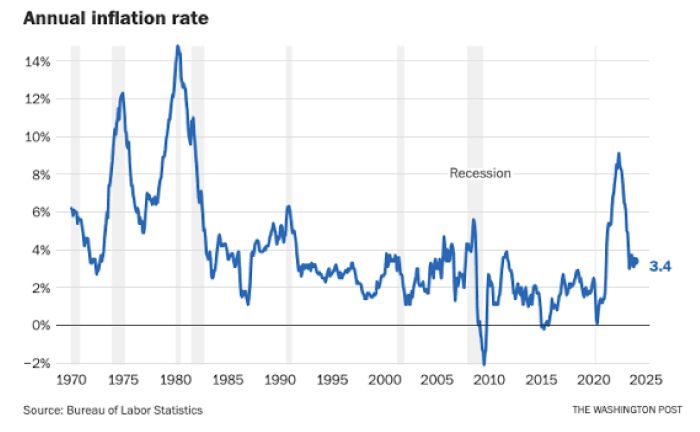
Annual Inflation Rate
1970 to Present
I also came upon this next graph which indicates the Cumulative Rate of Inflation from 2017 to 2026. Inflation rates are rounded, but you will notice if you add those rates up for ten years you will see that the “cumulative” effect of inflation for that time period is 40%. Using that number as a barometer, something you bought for $100 in 2017 would cost $140 today in 2026. . . . .A $10,000 funeral in 2017 would be expected to cost $14,000 today. . . . .While the rates change, that is the exact reason that funeral pre-arrangement policies have a growth factor to them — to cover inflationary costs as the years go by.
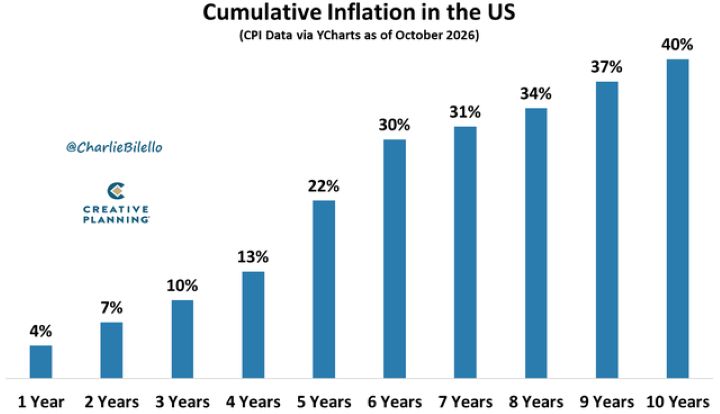
Cumulative Inflation
2017 to 2026
Here’s the Interesting Part: By looking at inflation and cumulative inflation in America over the past ten years, you would assume that American families that face a death are paying 40% more than they were in 2017. However, my research, while limited to two public companies but covering about 15-20% of American funeral market share, does not indicate that to be the case.
As a matter of fact, using data collected by Gemini AI which includes the annual reports of Service Corporation International and Carriage Services and public articles, such as this recent one from Yahoo Finance, I show a remarkable consistency of family funeral choices to increase in cost by only about 1.35% annually over the past decade. . . . . . . Of course, most of us know why — because people are choosing lower cost cremation services over traditional earth burial in record numbers.
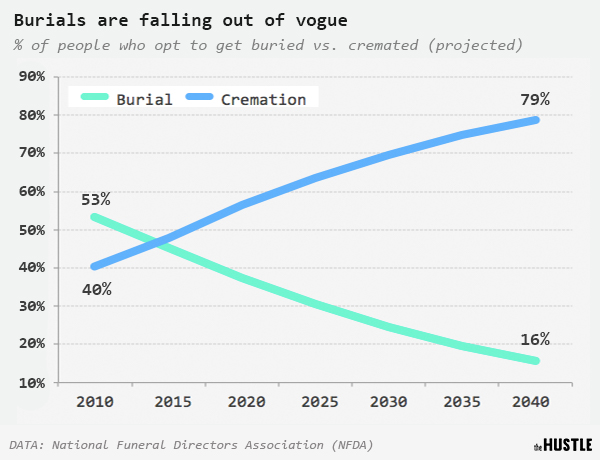
Cremation services, of almost all types, are simply less expensive than traditional burial funeral services.

Tom Anderson
Funeral Director Daily
Here’s What I Found: There are two publicly traded funeral home companies that between them are believed to serve 15-20% of the families with deaths in the U.S. annually. Both of these companies, Service Corporation International (SCI) and Carriage Services offer financial data of their businesses to their stockholders and the American public. Each of them has a category titled “Same-store” or “Comparable funeral home “Average Revenue per Contract” as one of their data points.
When I looked up the SCI “Comparable Average Revenue Per Contract” the number was listed as $5,285 for the fiscal year 2017 and the same category was listed at $5,992 for the 3rd Quarter of 2026. That’s a 13.37% increase over ten years or an annual increase of about 1.33% in “Revenue per case”
For Carriage Services the “Same-Store Revenue per Contract” was listed as $5,344 for fiscal year 2017 and $6,057 for fiscal year-to-date at the end of the 3rd Quarter of 2026. That works out to a 13.34% increase over ten years or 1.33% annual increase in “Revenue per case”.
SCI and Carriage Services have continued to grow in spite of low “Revenue per Case” growth because they have gained market share and added locations. SCI’s total revenue for 2017 was about $3.10 billion and for 2026 will be over $4.4 billion. The same dynamic has worked for Carriage Services as the company had total revenues of abou $258 million in 2017 and will be over $400 million in 2026.
Revenue is a Problem: I think that this little exercise pointed out to me that “Revenue generation is a growing problem” for traditional funeral homes. And, unless you are continually growing market share and adding locations, which help build scale to your operations, I don’t believe that you can “cut costs forever” to make up for less “Revenue per case” that seems to have no let up in sight.
Now, my little exercise is not scientific in nature and it does not count total “Memorialization” revenue which maybe includes a higher portion of revenue on such items one may purchase at the cemetery or post-cremation, such as Parting Stone or Eterneva. I do think that this exercise does show the difficulty in trying to replace revenue by simply raising prices on traditional services as at some point that price-point will drive consumers to a lower-cost cremation or similar service and disposition.
I think the evidence of NFDA’s recent Burial and Cremation survey points that out and that consumers are looking to re-define a Death Care experience in their own perception and funeral home owners and managers have to look on how they can capitalize on those trending aspects of Death Care at the same time that they continue to care for those asking for full-service traditional burial services.
For many in the business there is probably a “perspective change” that needs to happen. Take a look at the above graph that indicates that in less than 15 years, “burials” will only represent 16% of all death care dispositions. It used to be that traditional earth burials were the base of our business. If you haven’t changed already, you need to look to be more open to cremation services as the base to your business with traditional earth burials being an ancillary product that you provide. . . . . . . Once cremation is your base, and you find a way to profitability with that base, revenue should be able to be increased by more than 1.33% per year — it will have to be to absorb any inflationary costs.
It’s a hard perspective to change in ownership for experienced funeral home owners, but it is probably a shift that needs to be done.
Related Article (News Story) — West Fargo funeral director says costs continue to rise. Video news story and print article. Valley News Live (ND)
More news from the world of Death Care:
- AM Best revises outlooks to Positive for Funeral Directors Life Insurance Company. AM Best
- Returning to nature: How a historic Minnesota cemetery reopened for green burials. Video interview and print article. KEYC TV – Mankato (MN)
- As Christianity grows in Inda, burial space shrinks. Christianity Today.
Enter your e-mail below to join the 3,482 others who receive Funeral Director Daily articles daily
“A servant’s attitude guided by Christ leads to a significant life”