
Slow the erosion, relocate graves, or letting nature take its course. . . .



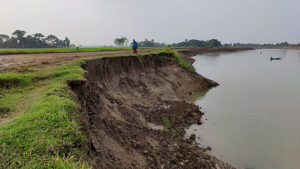
When it comes to a cemetery on a river bank and the river has moved the shoreline back over 20 feet in the past 30 years and you now realize that in the next couple of decades, as the erosion continues, you will be losing the cemetery — and the remains buried in it to the river — what do you do?
When you operate a business or are a board member of a non-profit there are decisions that are really tricky to deal with. . . .and this seems to be one of them. It’s difficult, not only because of finances or facts, but because of the emotions of generations of families who have members buried in those cemeteries.
This article (that includes several photos) from the Canadian Broadcasting Corporation tells of the problem that the Kuglutuk community of the Nunavut Territory of Canada will have to make. Simon Kuliktana, a member of the governing board, said, according to the article that the erosion isn’t a big problem now, but he expects it’s a process that will continue and that Kugluktuk will need to make a tough decision about the cemetery in the future. Relocation might be the only option, he said, even though it would be difficult. “It would bring out a lot of raw emotions, I think … if it came to that,” he said. “Removing our family from their final resting place. That’s probably the most emotional part. To me, that would be the most difficult.”
That’s not the only cemetery facing this difficult decision. Again, according to the article, in the Northwest Territory community of Fort McPherson a 2019 study said that “the slope beside Fort McPherson will have moved so far into town within 30 years that the ground will have given out below the community’s church, more than half the cemetery, the health centre and other homes and buildings.” That occurence would wash all of those properties into the Peel River.
The situation has come to the point that according to the CBC linked article “Miki Ehrlich, a partnership facilitator for the Northwest Territories Association of Communities, organized a three-day riverbank erosion workshop in Yellowknife. She also took it upon herself to do a presentation about cemeteries and erosion. Ehrlich said one of the challenges she’s observed during her eight years with the association is communities have to go to various agencies when dealing with erosion: they need engineers to see if structures can be moved, maps for making informed decisions and funding to make the work happen, for example.”
Dennis Wright, an attendee at the workshop made this comment upon its completion, “We have to find a safe place for our relatives,” he said. “Right now, the place that they’re buried is not a secure safe place.”
Funeral Director Daily take: I included this feature in Funeral Director Daily simply to point out all of the issues Death Care, as a community, can face. In my home community we have several small closed churches with the pioneers who built those churches and our community buried in the church cemetery. I can think of two of those cemeteries that back up to lakes where in my lifetime I’ve seen lots of shore erosion.
None of those cemeteries has the expertise or financial resources to shore up the shoreline or move the cemetery inhabitants. It won’t be in my lifetime but at some point those cemeteries will face the decision of this article’s title, “Slow the erosion, relocate graves, or let nature take its course”.
And, I’m guessing no one will want “nature to take its course” and vaults and caskets entering the lake.
I’ve served on some boards where I’ve had to take some tough votes and make difficult decisions on very difficult issues. And, I’ve also served as a CEO in private enterprise where some decisions are extremely difficult.
However, when you look at generational cemeteries and the issues faced in this article, I am extremely glad to have my board decision making behind me.
More news from the world of Death Care:
- Senior Guide: Creating a master plan to serve an ageing California. Bakersfield.com (CA)
- Giving our bodies back to earth: The Rise of Natural Burial. Longreads
- Cemetery vandalism sparks frustration in Wyoming town. Video news story and print article. KTVQ – TV 2 Billings (MT)
Enter your e-mail below to join the 3,201 others who receive Funeral Director Daily articles daily
“A servant’s attitude guided by Christ leads to a significant life”




1 Comment
Leave a Comment














I have worked for Eternal Reefs going on 7 years now.
We create Living Environmental Memorials, containing cremated remains, in the form of Reef Balls, that are placed in the Ocean, and have since 1998. Their life expectancy is 500 years.
One interested party wrote in and said “Leave the land to the living!”.
I can’t help but agree!