Colorado city tackles cemetery issue




The Lafayette (Colorado) City Council reached an agreement on what action to take to help those who have purchased lots in the Lafayette Cemetery and may not be able to use them due to conditions at the cemetery. You see, back in September 2025 it was discovered that the 150-year old cemetery had record keeping that left many prior burials undocumented. That discovery brought about the possible situation that many plots purchased for later use may already contain human remains.
Last November, as this archived article tells you, a moratorium was put on full-body burial at the cemetery until the total extent of the problem could be uncovered.
On July 21, 2026, the Lafayette City Council reached a decision on how the cemetery will go forward. Prior to doing so and to their credit, the city discovered that there was approximately 270 burial plots still privately owned or deeded but there was not physical space to honor all 270 potential burials. The graphic below comes from a meeting of the Lafayette City Council where they were considering options to, in some way, honor those 270 lot holders.
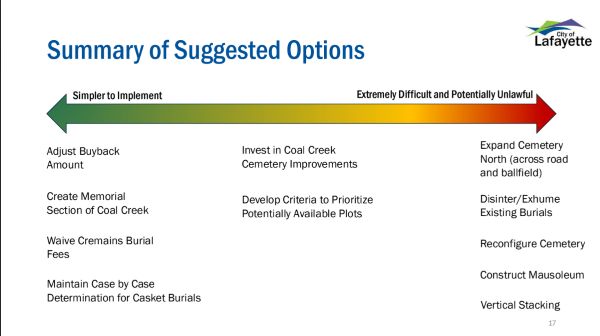
Options as discussed by the Lafayette City Council. (Screenshot / City of Lafayette)
At the July 21, 2026, City Council meeting a path forward was put in place by the council. You can see the options that the city resolution gives the lot owners here.
In essence, the Lafayette City Council gave existing lot owners the following four options as described in the resolution:
- Sell their plot back to the City for $3,500.
- Keep their plot for cremains burial, with the City covering the cost of one cremains burial per plot.
- Exchange their plot for one at Coal Creek Cemetery and receive a $2,000 refund.
- Maintain their plot for a future casket burial under the limited exception established by the resolution, if plot conditions show a casket burial might be feasible.
Lot owners are asked to contact the city by October 31, 2026, and complete their decision process by January 31, 2027.

Tom Anderson
Funeral Director Daily
Funeral Director Daily take: Regardless of what one thinks of the options presented I think you have to hand it to the city to see a problem and meet with affected parties to take a problem head on. This recent news clip from KUSA TV of Denver gives some idea of the emotions that are held by some with lots in the cemetery. . . . . And, that makes city council action difficult.
I served on the Board of Regents at the University of Minnesota for six years. That position showed me how difficult it was to make decisions for other people. There were many times that if I talked to three affected parties about an issue, all three had reasonable, but different solutions and ideas that might work. It was then part of my responsibility to vote on a decision that I felt would benefit the greater community the most. I learned that if you are trying to do the best for the “greater good” of the community, those are very difficult decisions.
I also think that there are probably many cemeteries that have this kind, and other problems, that may be undiscovered as of yet. When found, I would hope that they tackle the difficult issues as it appears the City Council of Lafayette has — with above board, transparent, insightful, and open communication to come to the best solution for the “greater good”.
Final Thought — I’m guessing that we would hear much more about this type of issue if traditional burial was still selected by the majority of Americans. The past 50-year growth of cremation and cremation burials, columbariums, scattering, and other cremation dispositions has probably, in many cases, headed off these “space issues” of smaller cemeteries.
More news from the world of Death Care:
- Tending: Interview with founder and CEO Artem Manilov about Digital Grave Care and Memorial restoration. Pulse 2.0
- A Dying Art: The Last of the Morticians. Harper’s Magazine
- How a trusted funeral director stole $1.1 million from Michigan’s most vulnerable residents. MLive.com (MI)
- Brown County survey finds 15-20 possible graves next to site of tiny homes for veterans. Video news story and print article. WLUK TV – Green Bay (WI)
Enter your e-mail below to join the 3,482 others who receive Funeral Director Daily articles daily
“A servant’s attitude guided by Christ leads to a significant life”