Private Equity: The “Exit” problem




As seems to happen to me quite often, probably because “the funeral home is my world” mentality was a result of growing up in the funeral home business, I tend to look at everything from a funeral home business perspective. Because of that I have days when I see different articles that form a sort of “Venn Diagram” of how the articles fit into funeral service.
I had one of those days the other day when I stumbled upon at least a trio of articles dealing with Private Equity (PE). One of those articles was all about Private Equity in the funeral business and another was about what is happening in Private Equity at this time with what it termed as a “slow down in PE exits.”
To give you an understanding of Private Equity in the North American Death Care business this article from a Vermont publisher will bring you up to date.
So, here is where I go on a little different tangent after reading that article and then seeing this article from Yahoo Finance titled “Retirement savers are keen to invest in Private Equity. Do they know what they are doing?”
As the linked Vermont article gets into and just knowing what we do about where some of the money for funeral home acquisition companies is coming from, some of us might ask the same question of the PE companies, “Do they know what they are doing?”
From my perspective I think it is pretty much common knowledge about the breadth or private equity investments in many regional and even national funeral home acquisition companies. Let’s see, there have been announcements about PE companies involved or at one time involved in several funeral home companies. This recent article from Dealseam names eight of the PE companies that, according to the article, are actively acquiring funeral homes.
Conspicuously absent from the listing in the link above is Death Care consolidator and operator Foundation Partners Group (FPG). At one point in time the company had secured an investment from Access Holdings but they are listed as a “Previous Portfolio Company” on the Access website. I have no idea why FPG is not currently listed in the Dealseam link as the company is probably in the Top 5 of Death Care operating companies on a revenue basis. It should also be noted, that while we have no figures from the private company that is Foundation Partners Group, many in the upper levels of Death Care management believe that Access Holdings exit from FPG was not profitable.
And, let’s not forget that this PE phenomena is not only in North America. Back in 2022, Epiris reportedly paid over US$ 533 million to acquire Great Britain’s Pure Cremation and TPG Capital of Fort Worth, Texas, and San Francisco, California, paid a reported US$ 1.25 billion to acquire Australia’s largest purveyor of Death Care (24.1% market share) InvoCare.
The Question??? — Can all of these private equity players in Death Care cash out for their shareholders profitably? In general, it is believed that most PE companies make investments with a 5-7 year holding period prior to a sale to a subsequent owner to cash out of the investment. Some sources, which includes the New York Times, say that at this time there is a “bottleneck” of unsold PE investments of about 34,000 companies, compared to about 16,000 a decade ago, with an estimated US $3.8 trillion in unrealized value.
Some sources suggest that that backlog of PE investments will take at least 8-11 years to clear out the existing inventory. . . . . noting that every PE backed purchase going forward simply adds to that future backlog of hoped for eventual exits.
Related Article — “Private Equity Holding Periods: Why Exits are taking longer. Capital Pad

Tom Anderson
Funeral Director Daily
How will funeral home consolidators eventually cash-out: It is my belief that for a long period of time purchasing a funeral home for “growth” was almost always a winning proposition. Traditional funeral services were very stable and grew in price every year. In addition, rural communities were population stable. One could operate that funeral home for a few years and then sell it for a profit.
Not Anymore — As you know, cremation is now popular with lower margins for funeral homes and the rural community has uneven demographics. It is to the point that population changes in many areas may be the biggest game changer in Death Care profitability for many rural funeral homes. As it stands now, geographic location with future demographics as a predictor may be the most important data point for the future value of some funeral businesses. Might that make some rural consolidators, in population declining areas, full of “lower-value” properties in their portfolio?
One issue that I can see brewing is who would be the acquirer when a regional company comprised of many small rural funeral homes wants to sell and cash out for their investors? I don’t see their individual funeral home volumes to be of interest to the national players who look to the largest 200-300 metropolitan areas of the country as their cut-off for minimum population volume.
Many of the communities where regional consolidators have their funeral homes are located in geographic areas that may have lost population as well as increased their product mix percentage to a higher portion of cremation. And, if the funeral home does not have viable call numbers and revenue as a standalone location who might the buyer be?
Take a look at the image below as well as this link about county growth/decline.
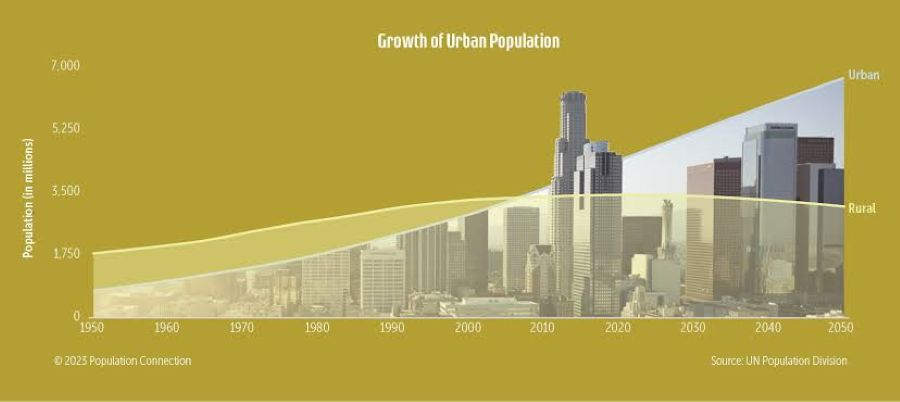
The Urban/Rural population change
The funeral home/high tech company conundrum — There are some that say the delay in “Exits” for high-tech investors is that purchasers want to make sure that the company they are about to purchase is not becoming obsolete with their technology in the fast-moving technology field. I think there is somewhat of a correlation in that regards with Death Care “Exits” or acquisitions. I believe that the acquiring company does not want to make a mistake on the mix of services — burial vs. cremation — that it is purchasing. And, simply seeing that mix change in a rapid fashion creates a problem in valuation for the buyer. Not an insurmountable obstacle, but buyer and seller may find it difficut to put a value on a funeral home that is rapidly changing its product mix.
I think we may eventually find a future when “buying” single family-owned funeral homes is easy. . . . . but there may be a real difficult challenge when a consolidator regional company wants to “Exit”. Who will be their buyer??
More news from the world of Death Care:
- Ex-Shelton man sentenced for computer scheme against funeral home. Patch (CT)
- Connecticut Funeral Directors Association members honored with national excellence awards. Patch (CT)
- Member of Parliament Alex Greenwich passes bill to legalize human composting in New South Wales. City Hub – Sydney (Australia)
- “The Green Goodbye” explores guests to explore eco-friendly final wishes. Waynedale NEws (IN)
- Member of Parliament vows to stop “distressing” 700-body mortuary opening in York. York Mix (Great Britain)
Enter your e-mail below to join the 3,482 others who receive Funeral Director Daily articles daily
“A servant’s attitude guided by Christ leads to a significant life”