What does a “K-Shaped” economy (or Consumer Divergence) mean for Death Care?




Back in 1971, according to this article from Pew Research Center, 61% of Americans fell into what was called the “Middle Class”. The same article lists that number as 51% in 1923, and according to Finance & Commerce magazine, “Most economists agree the K-shape (consumer divergence) isn’t a short-term anomaly but a continuation of long-term inequality trends, with some even predicting it will deepen”.
If you haven’t heard economists discuss what they see as a “K-shaped” economy where the affluent are the “upward slant” of the “K” and those wage earners who live paycheck to paycheck with little assets or savings are the “downward slant” of the “K” you will as the discussion gets more promininent. It seems to reflect what has happened to different cohorts of the populace since the pandemic with those that have assets seeing the assets grow in size and those without assets are seeing purchasing power erode as inflation of prices has moved upward and wages have stagnated.
This recent article from CNBC makes this comment about the situation, “Americans are increasingly diverging in their spending, with wealthier shoppers flexing their purchasing power while lower-income customers start to pull back.”
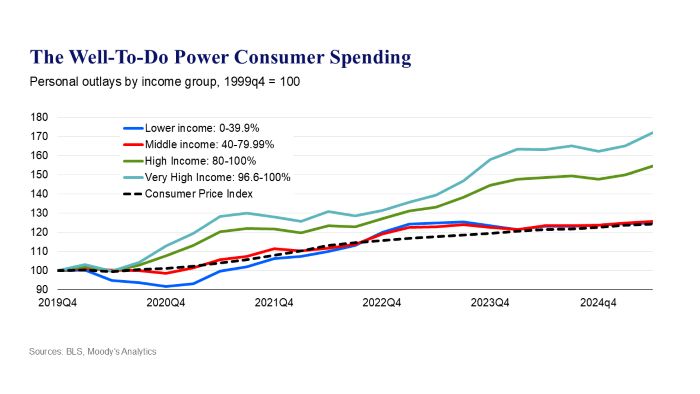
The following graph from Moody’s Analytics reflects the consumer spending ability of different income brackets. You can see that beginning in 2022 that the divergence really begins to happen. It is to the point that the “High” and “Very High” income brackets are carrying the consumer spending increases in America

Tom Anderson
Funeral Director Daily
Funeral Director Daily take: It is not Funeral Director Daily’s intent to reflect on the causes or political ramifications of this phenomena, but it is a great question about “How will this affect funeral homes, crematories, and cemeteries as they serve those with diverging abilities to pay?”
Back in 1971 when America had over 60% of its population as a part of the “Middle Class” I think it was easier to market a funeral home. In addition, the cremation percentage of dispositions in the U.S. was 4.78% according to at least one source. And, I think most of those cremation services were handled by cemeteries or crematories and not traditional funeral homes.
That left funeral homes to serve the 95% of the population who chose full-body earth burial. In essence, there was a single, generally low, service charge by the funeral home and the different “wealth consituencies” that they served differed themselves in their “consumer spend” on the funeral by the choice of casket and vault they chose. A funeral home that had pretty good data on their casket and vault averages had a pretty good idea of how to profit by setting their non-declinable “Service Charge” at the proper level.
Contrast that with the business of funeral homes today who have to figure out “who and how” to serve a much wider consumer financial ability breadth than ever before. . . . And, according to the data presented, most economists believe as noted above, that the consumer ability to spend gap will widen.
This consumer financial ability breadth is probably most seen in cemetery memorialization. As a matter of fact, Service Corporation International (SCI) has mentioned more than once in their Earnings Calls that their fastest growing sales at their cemeteries are what they term “Large Sales”, defined by them as sales of over $80,000.
And, at the same time there is a large and growing constituency that does not purchase post-cremation memorialization for their loved ones. Plastic and cardboard conatainers of cremated remains simply sit in closets at a survivor’s home. While many of these situations are by choice, there are those that come to that situation because of the cost of cemetery memorialization.
It is my opinion that it is probably a real challenge for traditional funeral homes and cemeteries to “price right”. One has to price “High enough” to make a good profit on those with a high ability to pay at the same time as pricing “Reasonable enough” to allow those with less financial resources to come to you for service and not be turned away to a “Low-Cost” provider, or in the case of cemeteries, no provider at all.
Traditional funeral home and cemetery owners, now more than ever, need to really “know”, not just think they know, the clientele in the neighborhoods that they serve. If you don’t you risk turning away the exact customers that can make you profitable.
Related Article — “K-Shaped” economy appears to deepen in the U.S.” Finance & Commerce (December 1, 2025)
Related Article — “This unequal economy is brought to you by the Letter K.” Medium (September 25, 2025)
More news from the world of Death Care:
- When you die, you could be the “whole forest”. Newser
- Relatives urged to talk about “at-risk” cemetery. BBC News (Great Britain)
- Funerals have become bulk of business for Michigan horse carriage company. Yahoo News
- Butler County families say loved ones were buried in wrong cemetery plots. Journal-News (OH)
Enter your e-mail below to join the 3,201 others who receive Funeral Director Daily articles daily
“A servant’s attitude guided by Christ leads to a significant life”