
Will the dispersion of Natural Organic Reduction soil be an issue?




Back in August the Worcester (Maryland) County Board of Zoning Appeals (BZA) approved Natural Organic Reduction (NOR) firm Earth Burial’s request to spread NOR soil on a 14-acre property in the county. According to this recent article from the Ocean City (MD) Today-Dispatch, the Worcester County Attorney has now filed a petition for judicial review to reverse that decision.
According to the article, families may take as much of the resulting soil that the NOR process produces for the deceased from Earth Funeral. Earth Funeral would then take any soil the family did not take and, with the family’s permission, use it for “reforestation projects”. That is where the purchase of the property, known as Snow Hill, in Worcester County would come in.
It should also be noted that the Snow Hill property is located approximately 130 miles away, in what is described as an agricultural area, from Earth Funeral’s facilities in Howard County, which is described as near both Baltimore and Washington, DC.
Again, according to the article, Roger Richardson, described as a neighboring farmer in Worcester County, and former Maryland agricutural secretary, has argued that Earth Funeral’s NOR reforestation project in Snow Hill would “permanently prevent productive farmland from being used to grow food”.
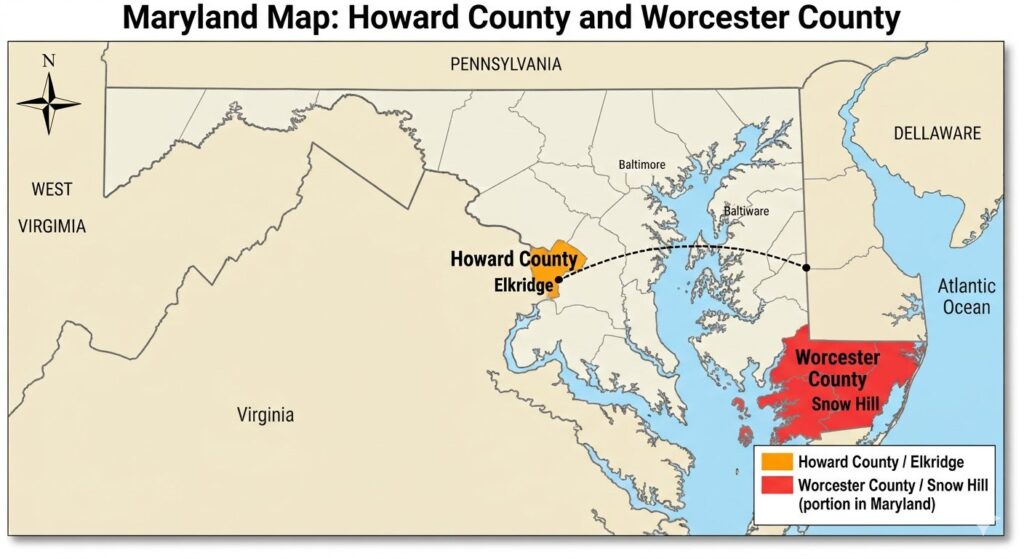
Map of Maryland with Howard County (Earth Funeral’s Facility) and Worcester County where the Snow Hill property is located.
“The 2024 law that legalized the composting process in Maryland also prohibits using the resulting soil to grow food for human or livestock consumption” according to the article.
Hugh Cropper, the attorney representing Earth Funeral is quoted in the article as saying the “The county planning commission had reviewed the proposal one month before the zoning hearing and offered no comments” and he also estimated that it could take six to nine months before the asked for judicial review reaches a courtroom.
Related: Natural Burial in 2025. Serenity Ridge Ntural Burial Cemetery – Maryland
Related: Embracing Green Death Care in Maryland: Sustainable alternatives in Death Care. Hamelburg Law

Tom Anderson
Funeral Director Daily
Funeral Director Daily take: There are bound to be these type of issues cropping up in several states as the state-by-state legalizations of Natural Organic Reduction and Alkaline Hydrolysis continue.
While we have had a 150-year history of dealing with cremation in the United States, NOR and Alkaline Hydrolysis are fairly new and different methods of human disposition. Anything that is “new and different’ will cause others to be wary of the situation and NOR and Alkaline Hydrolysis companies should be aware that this type of scrutiny will be the case in many instances.
This Maryland incident is not the first time that the issue of where will the final product of the process be accepted. Here’s a recent article from California’s Desert Sun titled “Outcry halts human remains composting on San Joaquin River in California“.
More news from the world of Death Care:
- Dutch start-up brings mushroom-made composting coffins to Australia. startupdaily.net (Australia)
- Push for more strict funeral industry regulations continues. Video news story and print article. Fox 21 TV – Colorado Springs (CO)
- Neighbors raise concrens over new crematory near homes, schools on East Street. Video news story and print article. KRCR ABC TV – Redding (CA)
Enter your e-mail below to join the 3,482 others who receive Funeral Director Daily articles daily
“A servant’s attitude guided by Christ leads to a significant life”





1 Comment
Leave a Comment














Natural organic reduction is becoming more popular, but it does pose an interesting question as discussed in your article. After running some calculations, the cremated remains material is 233 times more with natural organic reduction than it is with traditional cremation. About 1 : 233.
• Cremation: ~200 cu in ≈ 0.12 cu ft
• NOR: 1 cubic yard = 27 cu ft
27 ÷ 0.116 ≈ 233. Rounded for presentations, it’s roughly 1 : 230, or about 230 times the volume. Over the 3–8 lb range of cremated remains, the ratio falls somewhere between about 1 : 175 and 1 : 300.